
Op-Ed : CT Must Maintain its Fiscal Guardrails
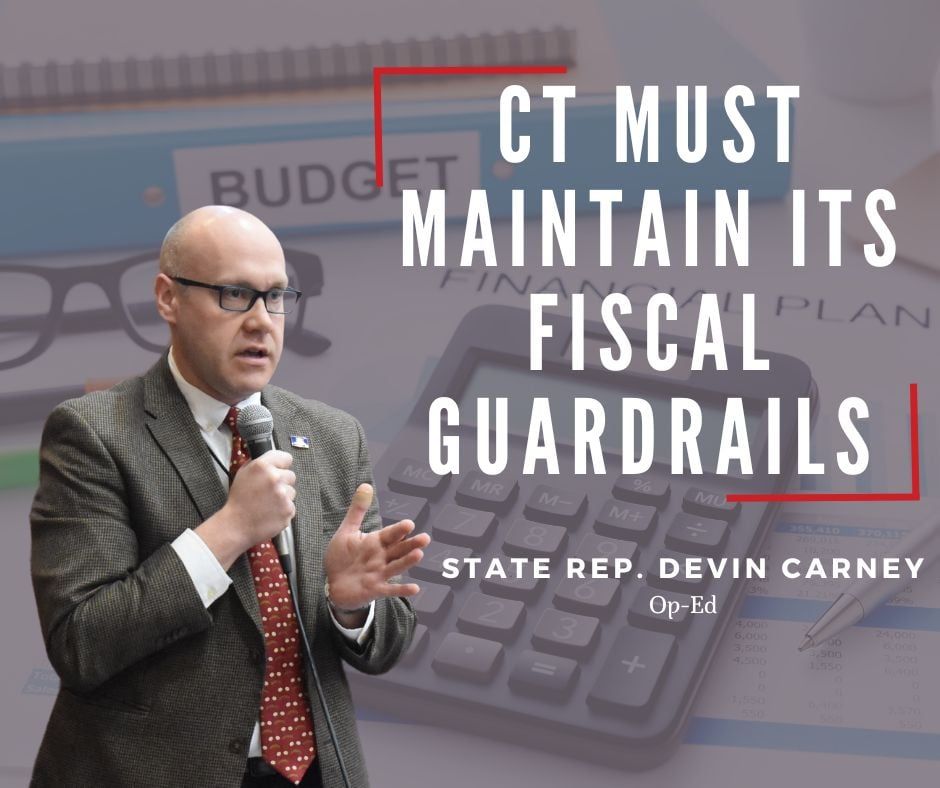
It wasn’t long ago that Connecticut was facing year-after-year fiscal crises due to budget deficits. In my first year as State Representative, the legislature passed $895M in tax increases (I voted no), which did little to invoke confidence in Connecticut’s future. Even with that additional revenue, the state still faced a deficit in addition to the gargantuan unfunded state employee and teacher pension liabilities and retiree healthcare costs. These unfunded liabilities resulted from overly-generous union-negotiated retirement packages that the legislature failed to fund in the past. Some poor investment performances exacerbated the problem.
Following the massive tax hike in 2015, the legislature punted the pension question and, in essence, refinanced tens of billions of dollars in debt to pass even further into the future (again, I voted no). Some things became clear – tax hikes wouldn’t solve the problem and the Connecticut economy could not fully improve unless government recognized its failures and began to seriously pay down these long-term costs.
In 2017, with the State Senate tied and a very closely divided House, a bipartisan budget was adopted to tackle our obligations. Included in this budget were a spending cap, revenue cap, and a volatility cap. The spending cap was not a new concept as the people of Connecticut voted it into our Constitution after the income tax enactment. However, it was never fully defined by the legislature and past legislators vastly overspent the new revenue generated by the income tax. Of course, the legislature failed to properly spend on our unfunded liabilities and left future legislators and future generations to deal with the problem. But, due to the closeness of the makeup in 2017, we were finally able to fully define what the public asked for 25 years prior.
The revenue cap forced the legislature to spend within its means by requiring a cushion between what is collected and what can be spent to ensure there is some breathing room. The volatility cap requires anything above $3.15B in excess revenues from certain ‘volatile’ sources of revenue, i.e. estimated and final tax payments, which tend to be based on how the stock market fares each year. With all of this the state has been able to pay down more than $7B in pension debt and Connecticut has a healthy rainy day fund – a very long way from the doom-and-gloom 2015 budget.
As we enter the 2024 session, many organizations and some Democrat legislators are calling for these caps to be tweaked to varying degrees. In some cases, organizations received bolstered one-time payments from federal COVID relief dollars. This federal money has since dried up and places like UConn are demanding the state start paying the difference. Governor Lamont has wisely pushed back arguing that the COVID funds were one-time and meant to carry an organization through the pandemic, not forever. There is no question the state can review its spending and try to alleviate where it can for certain human and social service organizations, but there should be no diversion from the path we are on.
Connecticut still faces $88B+ in debt, with over $40B coming from unfunded pension liabilities and another near $20B from retiree health care costs. These are fixed costs that must be paid and the sooner we pay them down, the better for Connecticut’s future. If the legislature begins to move away from the progress we have made, the costs and interest will rise and we could very easily be back where we were at the start. That is an unacceptable option. Connecticut has a duty to our future and that duty requires us to keep these fiscal guardrails in place.