Latest News
Loading articles...
Loading photos...

State Representative
District
44th
Towns
3
Latest Updates
Swipe through recent posts
.png)
Connecticut families are paying too much, and they are paying too much in taxes. That’s why I fully support the call to immediately suspend Connecticut’s gasoline and diesel taxes through the end of the year. Connecticut currently collects a 25-cent -per-gallon gasoline tax and a 49.9-cent -per-gallon diesel tax. Suspending those taxes, even temporarily, will ease the financial pressure families, workers, farmers, and small businesses in my district are feeling right now. To be clear: Connecticut government can afford to provide this relief. Our state has collected billions in taxes from hardworking people and businesses. When government has more money than it needs, we shouldn’t be looking for new ways to spend it. We should be looking for ways to return some of that money to the people who earned it. We can't forget that almost every tractor-trailer traveling on CT highways today is a diesel-powered truck, delivering essential products, like fuel, food or clothing to a business in Connecticut. And as diesel prices go up so do the cost of the goods on the truck. A gas-tax suspension would provide immediate relief at the pump. Suspending the gas and diesel taxes through December 31 is estimated to cost $128 million. Connecticut families shouldn’t have to choose between filling the tank, buying groceries, or paying the bills. It’s time to put taxpayers first and give some of their money back. I fully support suspending the gas and diesel taxes through the end of the year.
.png)
Plainfield Residents: New Update On the Proposed Waste-to-Energy Facility I want to keep residents informed about the latest developments regarding the proposed waste-to-energy facility in Plainfield. I attended the Connecticut Siting Council's October 1 st virtual meeting where they voted unanimously to grant the Town of Plainfield additional time to respond to questions and provide information as part of the ongoing review of the project and against moving to full certification process and against dismissal of this "fast track" application. The Town’s responses are now due October 15 , with an evidentiary hearing and public comment session scheduled for October 22 . Letter from Siting Council here: pe1719_extdcltr-towninterrogresponses_100126_a.pdf The important dates are as follows: Ø October 15: Town/developer responses and major filings due Ø October 22: Siting Council evidentiary hearing + public comment Ø February 3, 2027: Current final-decision deadline Ø August 2, 2027: Extended deadline available under the parties' agreement Importantly, no final decision has been made on the project . The Town of Plainfield continues to participate formally in the CT Siting Council proceeding and is putting its questions, concerns and evidence on the official record. I will continue to follow this process closely and keep residents updated as additional information becomes available. It’s important that our community understands what is being proposed and what it could mean for Plainfield before any final decision is made.
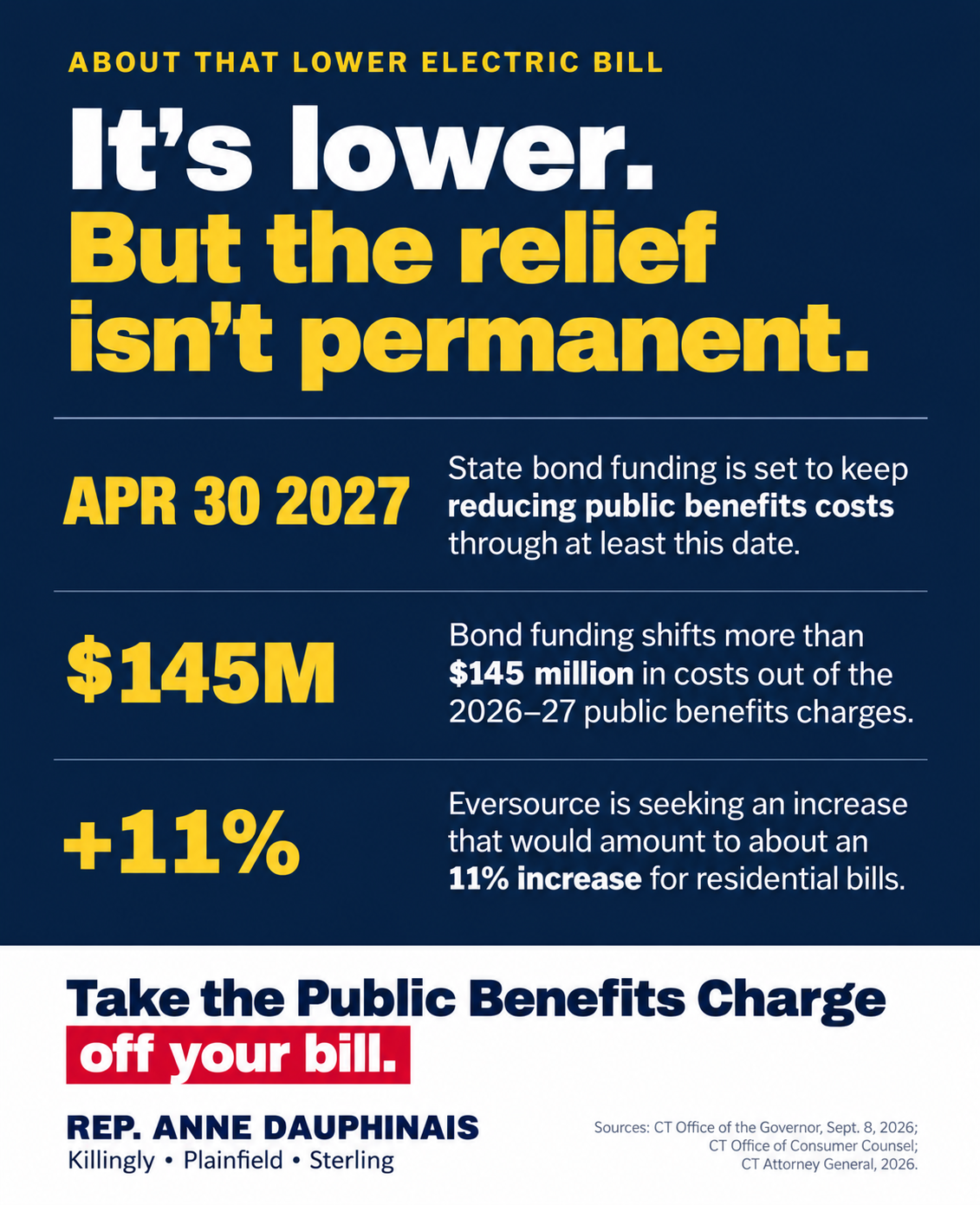
KILLLINGLY- State Rep. Anne Dauphinais had the following statement on high electric bills and the bad policies by the Democrats in Hartford that continue to hurt our state residents. “Connecticut, your electric bill isn't an accident. It's policy. Hartford Democrats want credit because electric bills dipped this year. Here's what they're not telling you. Most of that relief came from two things, a nuclear contract at Millstone that expires next April, and $300 million the state borrowed to cover charges on your bill. That borrowing gets paid back, with interest, by taxpayers. Meanwhile, Eversource is asking for a new 11% rate increase. The Public Benefits Charge on electric bills has cost Connecticut ratepayers approximately a billion dollars each year. It's a list of state programs Hartford decided you should pay for through your electric bill instead of the state budget. I've fought to take the Public Benefits Charge off your bill, and put it where it belongs, out in the open. People deserve to understand what they're paying for when they open their electric bill. Families in Killingly, Plainfield and Sterling can't afford more bad energy policy.”
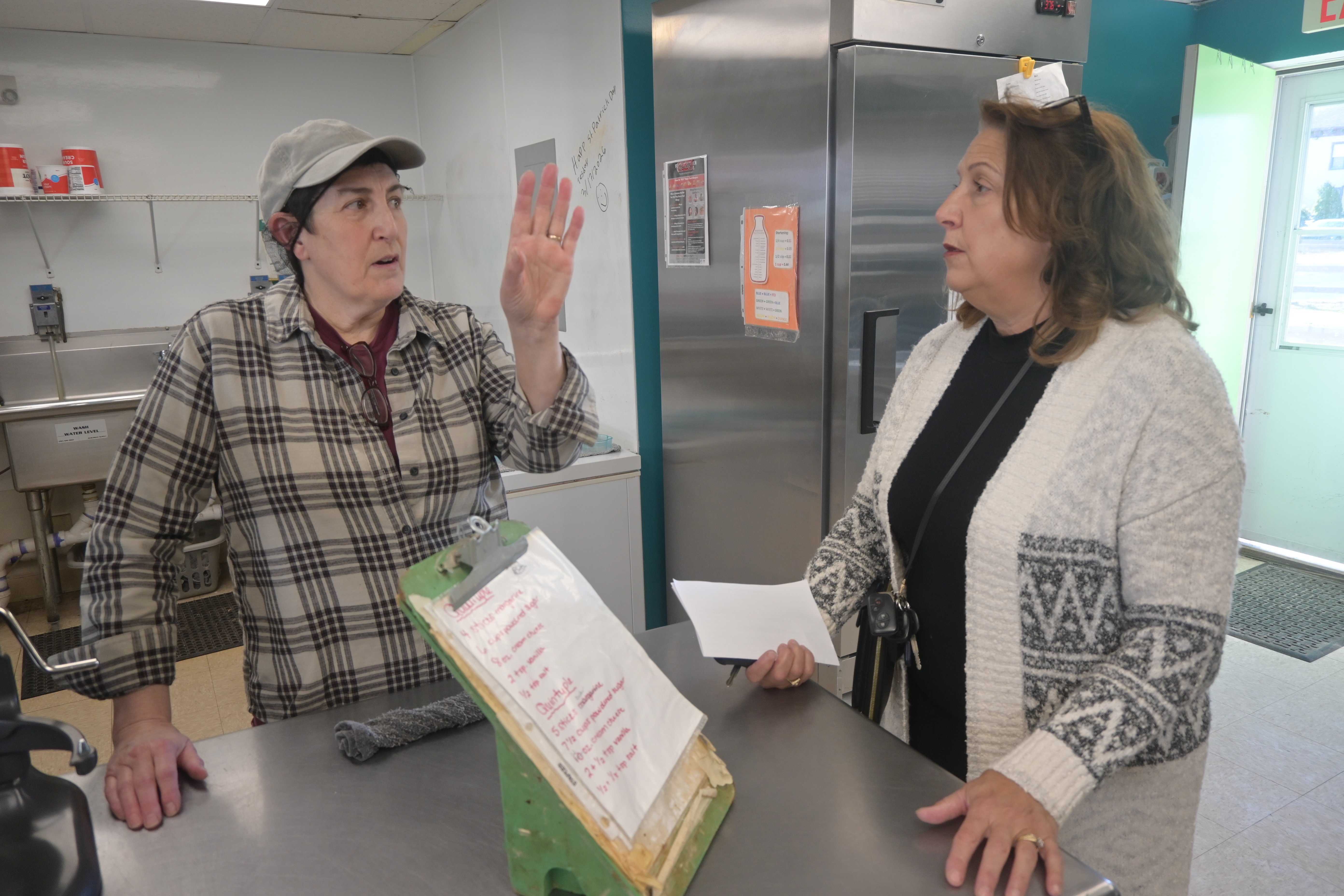
PLAINFIELD- State Representative Anne Dauphinais recently toured the Victorian Village Bakery in Plainfield, part of Seabird Enterprises, and saw firsthand the incredible work they are doing to create opportunity and independence for people with special needs and intellectual disabilities. Founded in 1983 with a cookie factory in Mystic, Seabird Enterprises was created to provide meaningful employment for individuals who often had few opportunities after completing their education. More than four decades later, that mission continues across locations throughout southeastern Connecticut. The Victorian Village Bakery is more than a bakery. It provides employment, transportation, training and opportunities to develop skills and become more self-sufficient. Their work even extends to volunteer opportunities with the Coast Guard and Navy Base in Groton. Anne was especially impressed by the innovation happening at the bakery, including the “Seabird Cookbook,” an app they designed to make recipes and instructions easier for employees to follow through audio and visual guidance. Rep. Dauphinais enjoyed the chance to learn about an organization that has spent decades building opportunity, dignity, and independence in the community. “I want to thank everyone at Seabird Enterprises for welcoming me and for the important work they do every day.”

KILLINGLY- State Representative Anne Dauphinais (R-44) updates area residents on state farmland policy and recommendations regarding (PA 490) Public Act 490. PA 490 is Connecticut’s land use law established in 1963 to fairly tax land based on its use and not on marketability to protect farmland, forests, and open space from permanent conversion. A PA 490 Working Group was formed following an outcry from farmers across Connecticut, who urged Governor Ned Lamont to reinstate the 2020 recommended land-use values under Public Act 490. In response, the Governor issued a moratorium in October 2025, effectively putting on hold an updated valuation that would have significantly increased the assessed value of some farmland for municipal tax purposes beginning in 2026. While the moratorium provided relief to some farmland owners by preventing those increases from taking effect, the reinstatement of the prior values did not provide similar relief to forestland owners. In fact, the updated values would have reduced the assessed value of forestland, making the moratorium particularly disappointing for those seeking meaningful recognition of the damage caused by insects and disease to Connecticut’s native trees and forest habitats. The PA 490 Working Group recommends modernizing Connecticut’s farmland valuation system so that assessments better reflect 1) how land is actually being used , while improving the data used to establish those values. The recommendations 2) replace the older soil-based classifications with use-based categories, 3) create annual reporting to provide more reliable rental information, 4) establish safeguards when there is insufficient data, 5) maintain the existing DEEP methodology for forestland, and (6) require an automatic review when land values increase by more than 20%. The overall goal is to make the valuation process more consistent and prevent unusually large assessment increases that could place additional pressure on farmland. The working group recommendations are now in the hands of Governor Lamont, the Connecticut Office of Policy and Management (OPM) and the CT Department of Agriculture, all who must decide whether to accept or reject them. While I was involved at the state and local level in understanding and advocating for appropriate action on this system of valuation, I believe the real thanks go to those members and volunteers who graciously gave of their personal time to see this effort through. I offer my deep appreciation to the farmers and foresters who dedicated so many volunteer hours to this endeavor. I know that the recommendations presented in these documents are the culmination of many months of public meetings, and behind-the-scenes commitment and coordination. The work of these volunteers really addresses the core issues that resulted in the underrepresented data and erroneous valuation of some agricultural lands and represents a comprehensive beginning to what should be ongoing discussions. There’s a lot to talk about, and I applaud the work that went into collaboratively developing these recommendations. My personal thanks to Jennie Kapszukiewicz from Stone Hill Farm in Plainfield for her thorough and thoughtful presentation. She is not only a constituent, but I consider her a friend and neighbor. PA490 Working Group Recommendations For questions regarding the material presented please contact: OPM.PA490@ct.gov
Towns Served