Latest News
Loading articles...
Loading photos...

State Representative
District
108th
Towns
4
Latest Updates
Swipe through recent posts
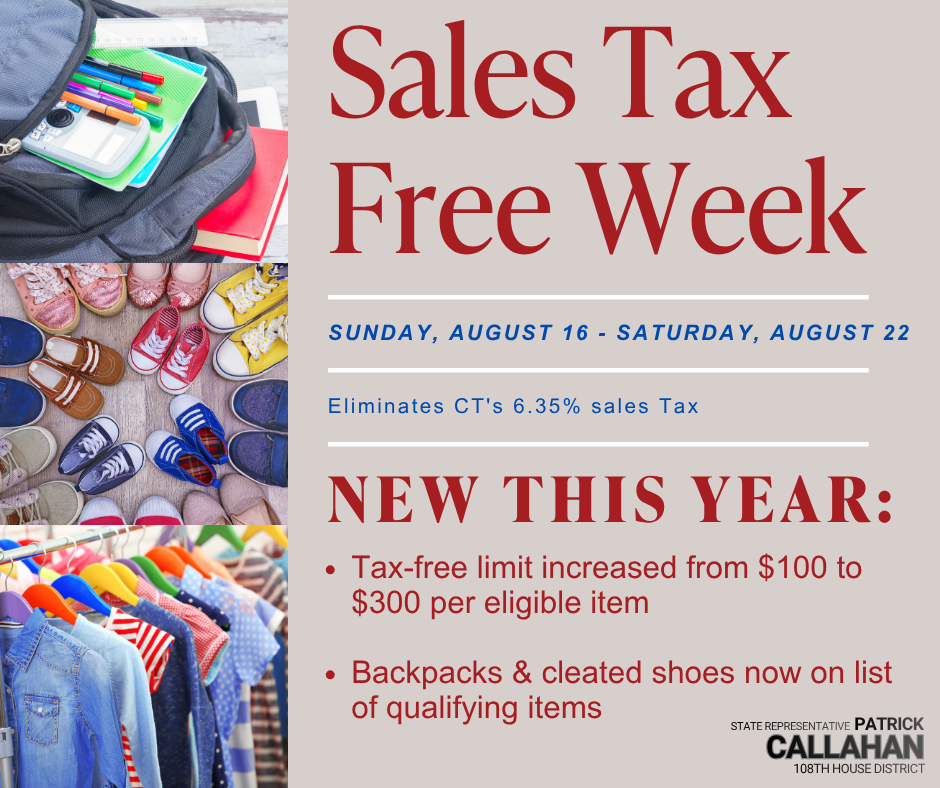
Connecticut's annual Sales Tax Free Week begins on the third Sunday of August and runs until the following Saturday. This year it’s August 16 through August 22, 2026. This is timed in the run up to the start of the new school year when families are shopping for back-to-school clothing. There are some changes to the program, starting this year. Under a bill I voted for, we've increased the price cap per item and added new items qualified as sales tax free. Now, backpacks and cleated shoes will be sales tax free during this upcoming event. This tax holiday applies to in-person purchases and purchases made online. The exemption applies to each eligible item costing under $300, up from $100, regardless of how many of those items are sold to a customer on the same invoice. Tax is calculated on the final sales price, after all reductions and coupons have been calculated, of each item. You can find answers to frequently asked questions about the program on the Department of Revenue Services website .
Several new laws will take effect July 1st that could have an impact on you, your business, or our community. I have highlighted some of them below. We passed an omnibus bill to help veterans , with several of the provisions taking effect soon. One creates the Military Department emergency response account, administered by the adjutant general, to cover state costs during certain emergencies. It also establishes state income tax deductions for compensation for an honor guard detail at a veteran’s funeral. One important bill we passed this session would bring more oversight to the state Department of Children and Families . The legislation also included provisions to establish grant programs for foster parents to cover the cost of afterschool programs for children in their care and for certain fictive kin (unrelated, trusted adult) caregivers to cover the cost of clothing, food, safety-related purchases, and other necessities for children in their care after an emergency placement. Another bill taking effect next month is one to bring more transparency and accountability to government spending . Entities receiving legislatively directed funds (known as earmarks) must be named, along with an explanation given of what the money will be used for. Neither are currently required. Any group subgranting the money to another entity must also get approval from state officials before doing so. Connecticut’s 6.35% sales tax will no longer apply to “nonelectronic school supplies” under the budget adjustment bill we passed. This includes, but is not limited to, things like binders, composition books, crayons, erasers, folders, glue, highlighters, index cards, lunch boxes, markers, notebooks, pencils, rulers, and scissors. We also expanded the amount of money on clothing and footwear that's exempt during Sales Tax Free Week, which takes place each August. The current exemption which applies to items under $100 will increase to under $300, and will also now include backpacks and cleated shoes. Other major acts include: An Act Concerning Oversight of Efforts to Prevent Human Trafficking An Act Concerning Online Safety An Act Concerning State-Wide Fire Protection An expanded list of those that will take effect on July 1, along with summaries, can be accessed here .

New Fairfield, CT – State Representative Patrick Callahan (R-108) is touting the success of three businesses in the area for their continued contributions to the local economy and community. Rep. Callahan recently met with family-owned Gil’s Auto & Truck Repair, Halas Farm Market, and the Goodie Shoppe to mark operational milestones, calling them pillars of the community. He also presented them with citations from members of the General Assembly, an honorary document recognizing achievements and community contributions. “Small businesses are the backbone of our community and these three are great examples of dedication to local residents,” said Rep. Callahan. “These businesses are part of a diverse jobs base in the greater New Fairfield and Danbury area and have stood the test of time.” During a celebration of Halas Farm Market’s 100 years of business, Callahan presented a citation to the Halas family. He commended them for their hard work, perseverance, and a commitment to quality locally grown food and plants. “Halas provided an especially valuable service during the pandemic when people were looking for locally sourced and accessible food as grocery store shelves became bare,” said Callahan. He also presented a citation recognizing 50 years of operations by Gil’s Auto & Truck Repair, started by Gil Hicks, now operated by his son, Tom, alongside grandson, Tyler. “I send my congratulations to Gil, Tom and all of their skilled employees for their 50 years of service,” said Rep. Callahan. “Just like the three generations that have worked at Gil’s, the family has built lasting relationships with generations of customers. Their service and customer care has earned the loyalty of many residents.” Rep. Callahan also recently presented a citation to Marc Jayson at the Goodie Shoppe as he retires after more than 30 years. “The Goodie Shoppe has been the gathering place for area residents, and part time job for dozens of local high school and college students. The tables are always full of people gathering to enjoy each other's company and conversation with wonderful treats from the bakery. The success of this business reflects the support of the residents of New Fairfield,” said Callahan. Callahan encouraged residents to continue supporting local businesses, noting that their longevity contributes to a strong local economy and a thriving community.

The Office of Legislative Research (OLR) has compiled its 2026 Major Public Acts report. This report details the action of the legislature in 2026, with brief summaries of major policy changes. More detailed summaries can be found at: https://cga.ct.gov/olr/ . OLR also produces a number of “Acts Affecting” reports highlighting legislation in various policy areas. Some of the topics covered in this report include: Aging Criminal Justice and Public Safety Education Energy Environment Human Services Insurance Public Health Veterans’ and Military Affairs To review the 2026 Major Public Acts report in its entirety, click here .

The House passed a budget adjustment bill this session that sends additional aid to cities and towns that they can use for tax relief to help with the rising education costs each municipality is facing, which could offset property tax increases. Representative Patrick Callahan highlighted some of the tax changes that may be of interest to residents. This budget adjustment creates a sales and use tax exemption for nonelectronic school supplies, like backpacks, lunchboxes, notebooks, pens, pencils, crayons, rulers, and paper. This will begin on July 1, 2026. It also increases the exemption amount for “sales tax free week” from $100 to $300 for clothing and footwear. Sales tax free week runs from the third Sunday in August through the following Saturday. Backpacks and cleated shoes costing less than $300 are now included in the exemption. Municipalities will be allowed to provide a $50,000 property tax exemption for taxpayers’ primary residences that are single-family homes or units in common interest communities or condominiums. Existing law allows municipalities to provide an exemption for certain owner-occupied primary residences. The bill prohibits municipalities from providing this exemption and the new exemption in the same assessment year. To adopt the new exemption under the bill, a municipality’s legislative body (or board of selectmen if the body is a town meeting) must vote in favor of it. The municipality may limit eligibility to taxpayers who meet length-of-residency requirements it sets. To be eligible for this exemption, taxpayers must annually file a form with their assessors declaring that (1) the dwelling is their primary residence, (2) they have no other primary residence, and (3) they have not claimed the exemption for any other residence that year. This will be applicable to assessment years starting on or after October 1, 2027. A nonrefundable income tax credit of up to $2,000 is also created in the budget adjustment bill for income-eligible family caregivers who incur eligible expenditures to care for and support an eligible family member. To qualify, the family caregiver must have federal adjusted gross income (AGI) of less than (1) $50,000 for single filers, married people filing separately, or heads of households or (2) $100,000 for joint filers. The credit equals 50% of eligible expenses incurred, up to a maximum of $2,000, for any tax year. Caregivers may apply the credit against their personal income tax liability, but not the withholding tax.
Towns Served