
Rep. Courpas Op-Ed: Let’s Stay the Course on Connecticut’s Fiscal Guardrails
As published in the Greenwich Sentinel and the CT Examiner:
Budgeting is an exercise in prioritization. We wish we could fund everything, but we can’t. Budgeting is even harder if one has a history of overspending, credit card debt, and external factors to manage. Welcome to CT’s current budget year! The 2025 session is uniquely challenging, but I believe that CT can accomplish our goals in a fiscally responsible manner which serves both our short- and long-term needs.
CT’s Budget – 2 challenging structural issues
Our state’s budget consists of approximately $26 billion per year of appropriations, funded like other states primarily through taxes and debt. However, CT has two unique structural challenges. First, we have one of the highest levels of pension debt per capita in the United States. We give extremely generous retirement benefits to state employees, but these obligations exceed the money we’ve put aside to pay them. The shortfall is approximately $35 billion – a huge sum which functions like the state’s credit card debt. Since we don’t have the money to “pay it all off,” we pay the minimum balance (hundreds of millions) to meet each year’s obligations. This is more costly in the long run.
Our second problem is that the state went on spending binges for decades, especially in the mid-2000s. We grew a large state government and established habits we could not afford, habits which continue. Between 2019 and 2025, state employee pay grew by 33%. When you consider that the state’s economic growth over that period was closer to 4.9%, that growth of government pay is staggering and in fact, unfair to the rest of the state.
What’s worse is that the above two structural problems work together to our detriment. As long as we continue increasing state employee pay, we are also increasing what the state will owe that person for years after their retirement. Paying down pension debt while doing that is like digging out of a hole with the right hand while adding the dirt back at twice the pace with the left.
We began to fix our problems in 2017
In 2017, CT took a quantum financial leap forward and enacted CT’s “Fiscal Guardrails.” A combination of a Revenue Cap (limits spending to less than tax revenues), Spending Cap (caps spending at inflation/income growth), Volatility Cap (directs investment income into the Reserve fund) and the Bond Lock (locks the guardrails into bond covenants) were passed by the legislature, and the Guardrails were born.
They have worked! Because of the Guardrails, the state made $7.4 billion in contributions to its pension fund, freeing up $730 million yearly, and grew its budget reserve fund from $212 million in 2017 to $4.1 billion today. The impact would have been much more if we had not continued to increase employee salaries over the same period. This began to address both of our long-term issues, with great results.
But $2.8 Billion of Federal relief funds for COVID caused us to overspend again between 2021-24
The $1.9 trillion Federal bailout for COVID relief provided a massive “slush fund” which helped us avoid difficult choices. CT received $2.8 billion in ARPA (American Rescue Plan Act) and other COVID funds to deploy between 2021-24. Most of those one-time funds were deployed for COVID-specific, one-time needs. But unfortunately, some of the funds were used to prop up operating shortfalls in other areas of the budget. In effect, we used federal COVID-relief money to fill non-COVID holes and spent over the Spending Cap.
The last of the Federal COVID-relief funds were required to be contracted in 2024. So, the Federal bailout “sugar rush” as some have called it, is over.
It didn’t look so good coming into 2025
2025 was set up to be a difficult budget year from the start. The “budget Novocain” provided by COVID relief money was gone, and the pain of the operating shortfalls it numbed was back. People had begun to rely on worthwhile COVID support programs – but the money to continue them was gone. To make it worse, certain expense items in the 2025 budget had large cost overruns. For example, Medicaid alone is projected to finish 2025 at $225 million over what was budgeted.
Finally, add the uncertainty of “Federal Budget Cuts”
Jan. 2025 brought a new Presidential administration, which has stated that it is shrinking Federal government and shifting certain responsibilities to the states. As a state legislator, I am ready to problem solve for the state’s citizens on any shortfall created by Federal cutbacks and fund gaps at the state level if needed.
The situation changes daily, but as of the writing of this column (April 30), I am at a loss to identify exactly what that shortfall is.
At an Appropriations Committee meeting recently, I asked approximately 10 different department heads whether they had an actual number in either their 2025 or 2026 budget which had been cut. The answer was repeatedly “no” or “we don’t know yet.”
The $150 million of “cuts” to the Department of Public Health (DPH) received much press, and understandably so given the vital nature of services DPH provides to our citizens. But many of these “cuts” represented the cessation of COVID-related Federal funding.
These programs were beneficial and represent a painful loss. But there is a big difference between a program which stops because one-time COVID bailout money is no longer available versus a Federal “cut” to a foundational part of CT’s budget or a pre-COVID program. We did without these programs before COVID – why do we need them now? It is a question worth asking and answering in our budgeting process.
I am certain that there are and will be Federal cuts which will affect CT. I am not minimizing their impact. But we must distinguish between “anticipated” cuts and actual cuts, and plan without panicking. The Governor stated it well recently: “I don’t want to overstate what’s going on because every day it changes. I can’t say it hasn’t happened yet, so why worry about it? We are ready, and we are prepared.”
So, what do we do with our 2025 budget?
As a moderate policymaker, I believe that:
- We must decide what CT’s priorities are, fund those and fund them effectively.
- We must freeze state employee pay raises for at least two years. The rate of increases is unsustainable.
- Adhering to CT’s Fiscal Guardrails is an imperative. There is a fiscally prudent budget we can develop, which reflects our priorities and doesn’t break the spending cap. The Guardrails also enable us to keep paying down our “credit card debt”, aka pension liabilities. The Appropriations Committee approved a budget this week which broke the Guardrails. I do not believe that was prudent.
- CT needs to pass a state budget by June 4, and we will probably have to do it with incomplete information about Federal budget cuts. So, let’s work with what we know for a fact. We cannot budget based on fear, anticipation and “what-ifs.”
- The Legislature should be prepared to revisit our budget (in a special session or otherwise), if additional verified needs arise as a result of Federal cuts. We must provide for our citizens.
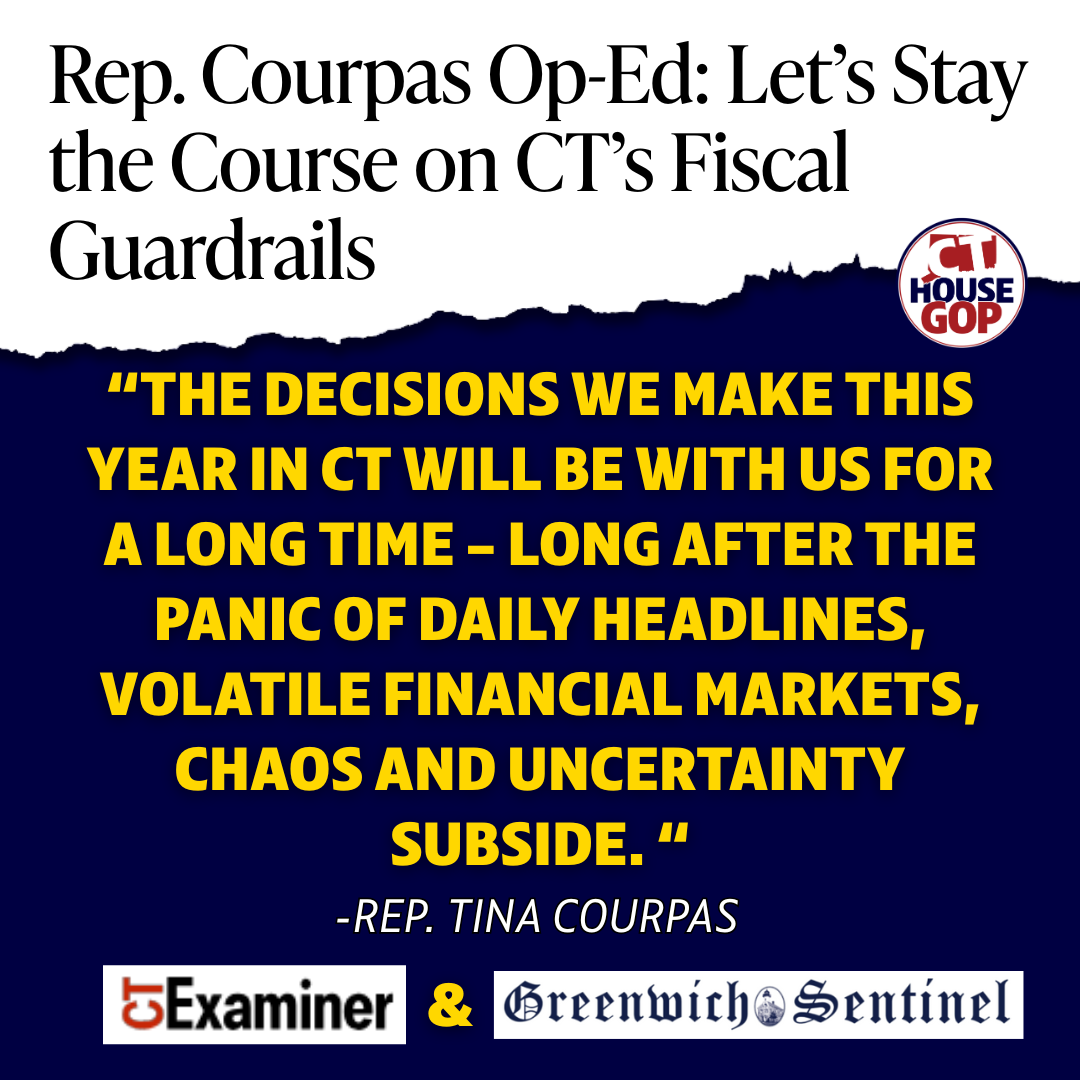
The decisions we make this year in CT will be with us for a long time – long after the panic of daily headlines, volatile financial markets, chaos and uncertainty subside. Let’s stay the course on CT’s Fiscal Guardrails. If we don’t, our taxes will go up. Let’s proceed with moderation. Let’s plan, not panic.
State Representatives Tina Courpas
149th District