BOLINSKY, HOUSE REPUBLICANS ANNOUNCE PANDEMIC RELIEF PACKAGE TO HELP RESTAURANTS & BARS
HARTFORD—State Rep. Mitch Bolinsky (R-106) joined his House Republicans colleagues on Wednesday to unveil emergency legislation to aim at providing much needed relief to the owners of Connecticut restaurants and bars that have been hit extraordinarily hard during the COVID-19 pandemic.
The public health emergency, subsequent government-mandated closures, operating-capacity limitations and other restrictions have decimated the hospitality industry and has, thus far, led to the permanent closure of more than 600 Connecticut restaurants, with hundreds more currently on the brink of closure. This has cost thousands of employees their livelihoods already and, without a helping hand, could potentially lead to thousands more without a job to go to.
“Our small ‘mom and pop’ restaurant and bar owners are important employers, tenants and, at the same time, provide our communities their own ‘special flavor’. These local establishments are our ‘gathering places’, even though we’re not gathering at this time. In a year without holiday parties and traditional weddings, it’s plain to see how we need to preserve the purveyors of good times. And, let’s not forget that these businesses are benefactors in the communities, sponsors of local youth sports and more, in addition to paying their fair share of taxes and permit fees they still dutifully pay, even in these times of lost revenue. They need a financial lifeline now. Not a day goes by that someone in this industry doesn’t reach out to me and ask us for help. With the new legislative session starting on January 6, we have an opportunity to provide real relief for these important drivers of our state economy,” said Bolinsky.
The House Republican caucus will propose legislation, focused on bars and restaurants, to:
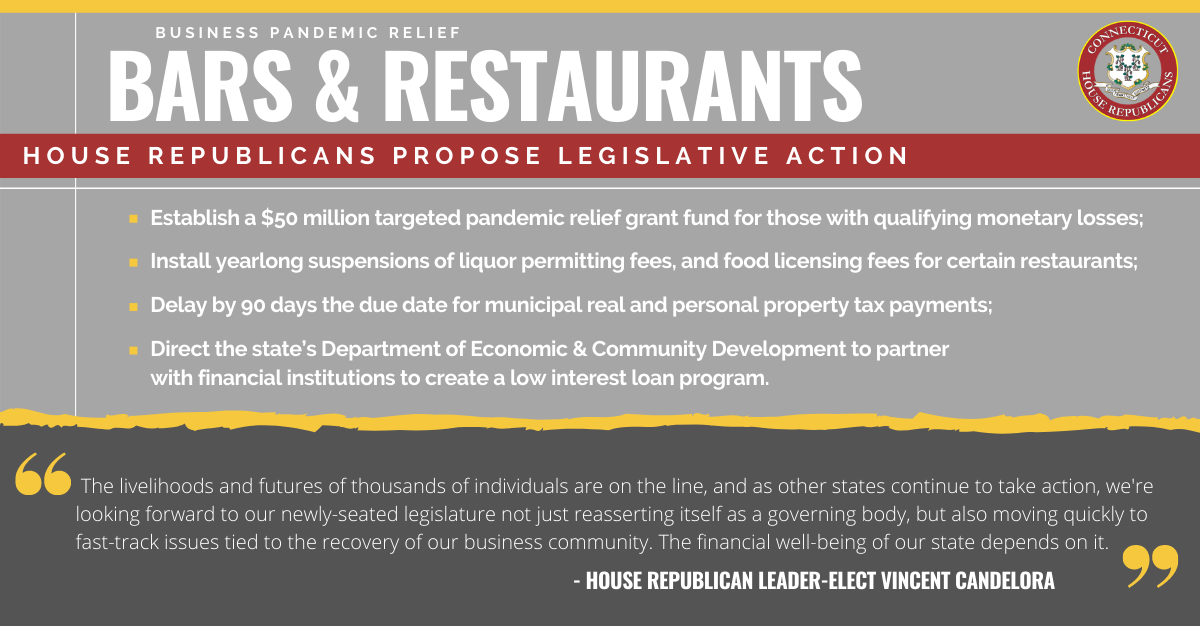
- Establish a $50 million targeted pandemic relief grant fund for those with qualifying monetary losses;
- Install yearlong suspensions of liquor permitting fees, and food licensing fees for certain restaurants;
- Delay by 90 days the due date for municipal real and personal property tax payments;
- Direct the state’s Department of Economic & Community Development to partner with financial institutions to create a low interest loan program.
The governor has pledged to help the industry but so far has yet to spell out exactly what that means, or whether he will use remaining federal CARES Act funds to do so.
Bolinsky concluded, “I believe this is a good start in the process of building-out a plan to bring this segment through the pandemic. Is it enough? I don’t think so, Bolinsky said. There are other business segments that also need relief and, waiting for Congress to act is not a good plan. Stabilizing the hospitality business is probably not going to bring back most of the unique establishments already lost but, if we can relieve some of the pressure and hold on to what we have, it gives the industry something of a platform upon which to rebuild.”