Latest News
Loading articles...
Loading photos...

State Representative
District
112th
Towns
3
Latest Updates
Swipe through recent posts
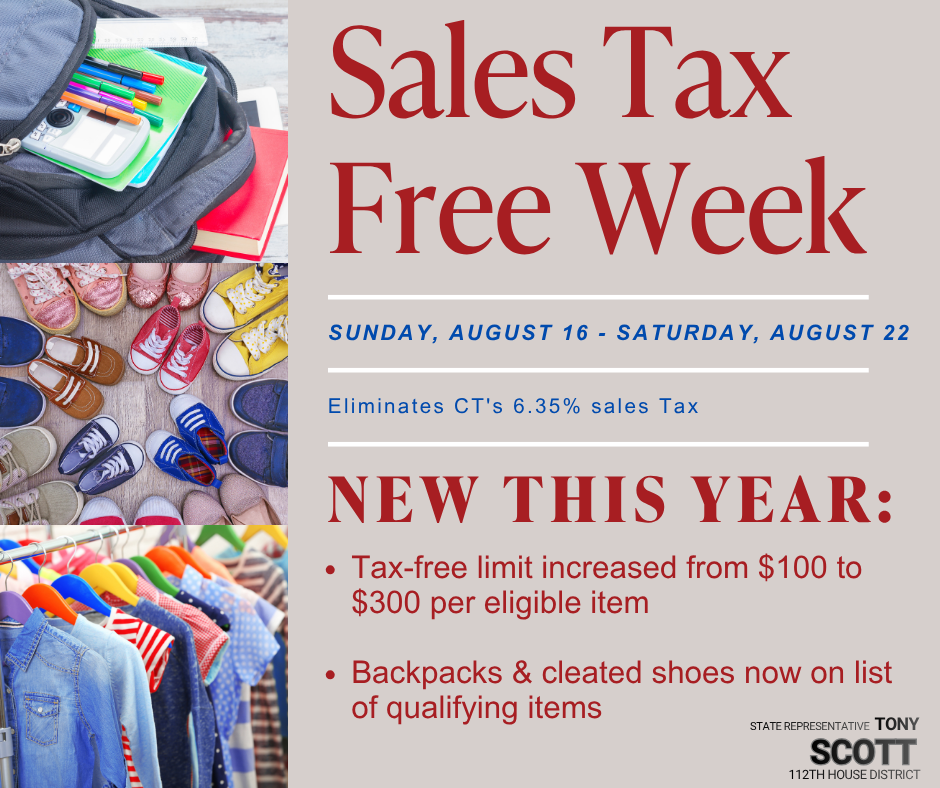
Connecticut's annual Sales Tax Free Week begins on the third Sunday of August and runs until the following Saturday. This year it’s August 16 through August 22, 2026. This is timed in the run up to the start of the new school year when families are shopping for back-to-school clothing. There are some changes to the program, starting this year. Under a bill I voted for, we've increased the price cap per item and added new items qualified as sales tax free. Now, backpacks and cleated shoes will be sales tax free during this upcoming event. This tax holiday applies to in-person purchases and purchases made online. The exemption applies to each eligible item costing under $300, up from $100, regardless of how many of those items are sold to a customer on the same invoice. Tax is calculated on the final sales price, after all reductions and coupons have been calculated, of each item. You can find answers to frequently asked questions about the program on the Department of Revenue Services website .
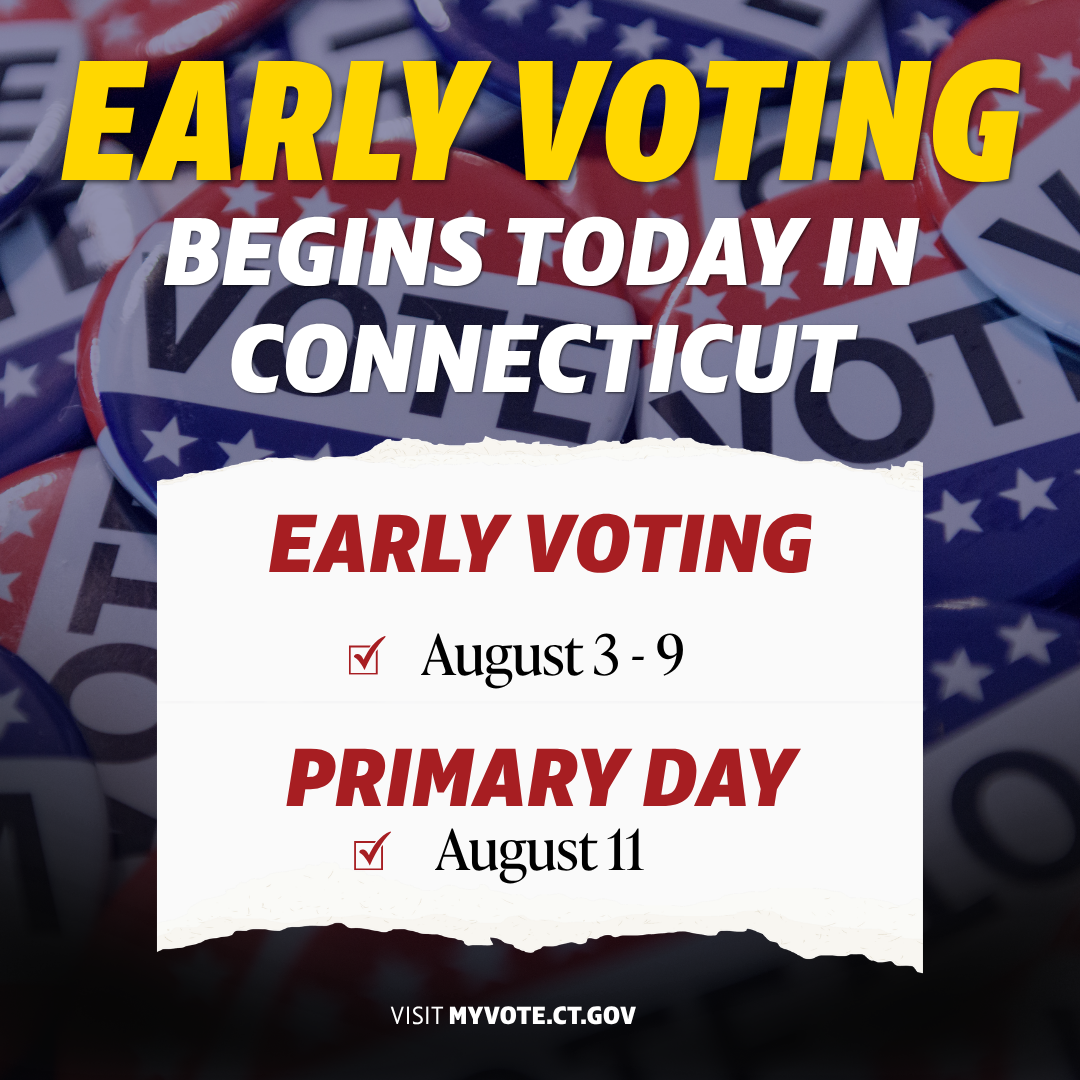
Early voting for the August 11, 2026 Primary is underway. Democratic and Republican Primaries will be held on Tuesday, August 11 , 2026, 6 AM to 8 PM at the following locations in Monroe: Democratic Primary: All districts (1, 2, 3 & 4) Governor District 1: Fawn Hollow Elementary School, 345 Fan Hill Road USE Main Entrance District 2: Stepney Elementary School, 180 Old Newtown Road USE Main Entrance District 3: Monroe Elementary School, 375 Monroe Turnpike USE Main Entrance District 4: Masuk High School, 1014 Monroe Turnpike USE Main Entrance Republican Primary: All districts (1, 2, 3 & 4) U.S. Representative in Congress 4 District 1: Fawn Hollow Elementary School, 345 Fan Hill Road USE Main Entrance District 2: Stepney Elementary School, 180 Old Newtown Road USE Main Entrance District 3: Monroe Elementary School, 375 Monroe Turnpike USE Main Entrance District 4: Masuk High School, 1014 Monroe Turnpike USE Main Entrance Primary Day, Tuesday, Aug. 11, polls will be open from 6 a.m. to 8 p.m. at the Staples Elementary School Cafetorium in Easton . Primary Day, Tuesday, Aug. 11, polls will be open from 6 a.m. to 8 p.m. for District 4 in Trumbull at Madison Middle School. Only registered Democrats or Republicans can vote in their respective Primary. EARLY VOTING for these Primaries will be available August 3 – 9, 10 AM – 6 PM, 8AM – 8PM on August 4 and 6. Locations: Community Center Site , 709 Monroe Turnpike, Monroe. Community Room at the Easton Library 691 Morehouse Road Community Room at the Trumbull Library at 33 Quality Street
Several new laws will take effect July 1st that could have an impact on you, your business, or our community. I have highlighted some of them below. We passed an omnibus bill to help veterans , with several of the provisions taking effect soon. One creates the Military Department emergency response account, administered by the adjutant general, to cover state costs during certain emergencies. It also establishes state income tax deductions for compensation for an honor guard detail at a veteran’s funeral. One important bill we passed this session would bring more oversight to the state Department of Children and Families . The legislation also included provisions to establish grant programs for foster parents to cover the cost of afterschool programs for children in their care and for certain fictive kin (unrelated, trusted adult) caregivers to cover the cost of clothing, food, safety-related purchases, and other necessities for children in their care after an emergency placement. Another bill taking effect next month is one to bring more transparency and accountability to government spending . Entities receiving legislatively directed funds (known as earmarks) must be named, along with an explanation given of what the money will be used for. Neither are currently required. Any group subgranting the money to another entity must also get approval from state officials before doing so. Connecticut’s 6.35% sales tax will no longer apply to “nonelectronic school supplies” under the budget adjustment bill we passed. This includes, but is not limited to, things like binders, composition books, crayons, erasers, folders, glue, highlighters, index cards, lunch boxes, markers, notebooks, pencils, rulers, and scissors. We also expanded the amount of money on clothing and footwear that's exempt during Sales Tax Free Week, which takes place each August. The current exemption which applies to items under $100 will increase to under $300, and will also now include backpacks and cleated shoes. Other major acts include: An Act Concerning Oversight of Efforts to Prevent Human Trafficking An Act Concerning Online Safety An Act Concerning State-Wide Fire Protection An expanded list of those that will take effect on July 1, along with summaries, can be accessed here .
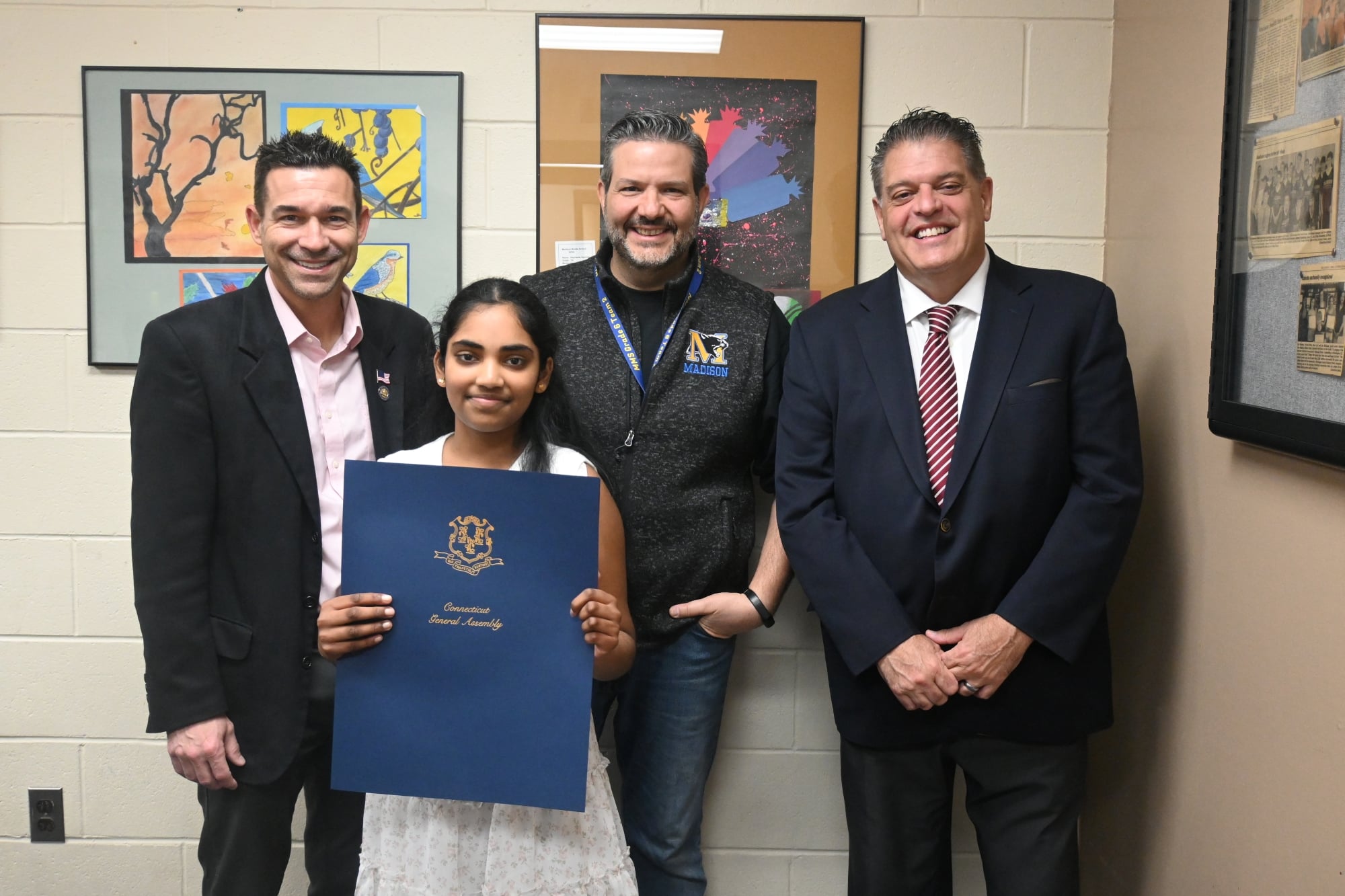
Photo Caption: State Representative Tony Scott, Shanvi Panthangi, 6 th grade Social Studies teacher Robert Reda, State Representative David Rutigliano. TRUMBULL — State Representatives David Rutigliano (R-123) and Tony Scott (R-112) recently honored the winner and runner-up of their 11 th Annual House of Representatives Women’s History Month Essay Contest during a ceremony at Madison Middle School. Earlier this year, the legislators partnered with Madison Middle School to invite sixth-grade students to participate in the contest as part of Women’s History Month in March. Students were asked to submit essays on the topic: “Important Women in Connecticut’s History and How Their Contributions to the State and Nation Affect Me.” Each student wrote a 300-word essay highlighting a notable Connecticut woman, exploring her life, accomplishments, and the personal impact of her contributions. During the ceremony, the first-place winner shared thoughtful reflections on an influential woman in history and her personal connection to the subject. “This contest is a great way to engage students in learning about the important role women have played in shaping our state and nation,” said Rep. Rutigliano. “I want to thank all the students for their hard work. They are outstanding representatives of Trumbull, and I was truly inspired by their presentations.” “I want to congratulate our contest winners for going above and beyond in their work,” said Rep. Scott. “Each student submitted a well-researched and meaningful essay, and it’s encouraging to see this level of effort and enthusiasm.” Madison Middle School Winners: Winner: Shanvi Panthangi — Rosa Ponselle Runner-Up: Catalina Andrade — Prudence Crandall
The Office of Legislative Research (OLR) has compiled its 2026 Major Public Acts report. This report details the action of the legislature in 2026, with brief summaries of major policy changes. More detailed summaries can be found at: https://cga.ct.gov/olr/ . OLR also produces a number of “Acts Affecting” reports highlighting legislation in various policy areas. Some of the topics covered in this report include: Aging Criminal Justice and Public Safety Education Energy Environment Human Services Insurance Public Health Veterans’ and Military Affairs To review the 2026 Major Public Acts report in its entirety, click here .