
Capitol Update: Small Business Grant Applications Now Available
I would like to provide a quick update on the following items:
- Applications now available for CT CARES Small Business Grant Program
- Two states added to tri-state travel advisory, no states removed
- DPH provides new guidance for youth/recreational sports activities
- Reminder: CT now in Phase 2.1
- PURA announces standard rate changes for Eversource
CT CARES Applications Now Available
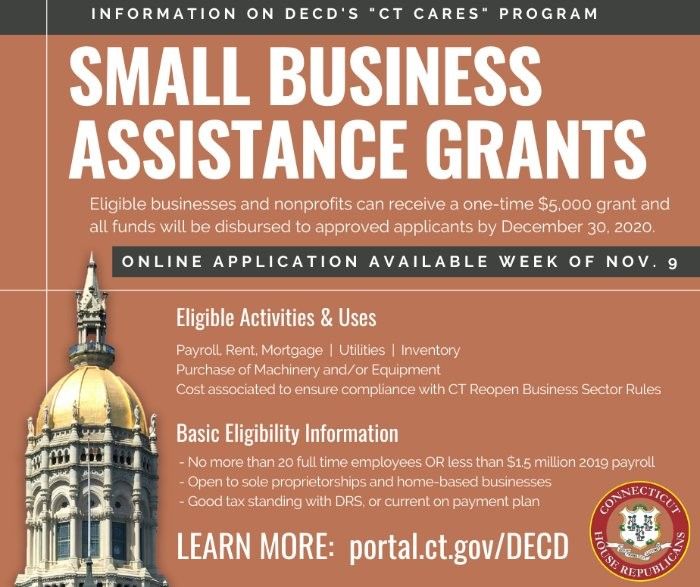
The CT CARES Small Business Grant Program is now accepting applications. Businesses and nonprofits with 20 or fewer employees OR annual payroll of less than $1.5 million as of 12/31/2019 are eligible to apply.
The one-time, $5,000 grants will be distributed through the Department of Economic and Community Development (DECD) from an available total of $50 million. This means only 10,000 organizations will receive a grant.
All funds will be distributed to approved applicants by December 30, 2020.
If your business meets the criteria, please apply here as soon as possible.
Grants can be used for:
- Payroll
- Rent/Mortgage
- Utilities
- Inventory
- Purchase of Machinery and/or Equipment
- Compliance costs for CT Reopen Business Sector Rules
Which small businesses/nonprofits ARE eligible?
- Those with 20 or fewer full-time employees OR annual payroll of less than $1.5 million as of 12/31/19
- Those with 20% or more loss in revenue year to date as of September 30, 2020 compared with the same period in 2019
- Those who were established by October 1, 2019 and still are active
- Those who have passed a Department of Revenue Services (DRS) tax status review. To avoid potential delays in processing your application check your DRS status here
- Home-based businesses and Sole Proprietors
- Those who already received federal Paycheck Protection Program (PPP), Economic Injury Disaster Loan (EIDL), and/or CT Bridge loans are still eligible
Ineligible businesses/nonprofits:
- Medical marijuana
- Liquor stores and alcohol distributors
- Adult businesses such as strip clubs
- Vape retailers
- Tobacco shops and smoking lounges
- Businesses having to do with gambling
- Gun stores and ranges
- Cash advance, check cashing, or pawn shops
- Bail bonds
- Collection agencies or services
- Auction or bankruptcy or fire or “lost-our-lease” or “going-out-of-business” or similar sale
- Arts/cultural organizations that have already applied for CARES grants
If you have additional questions, call the DECD hotline at (860) 500-2333 or email DECDCTRecovery@ct.gov. You can also visit https://business.ct.gov/.
Updated Travel Advisory
As of November 10, New Hampshire and Maine have been added to the tri-state travel advisory created by Connecticut, New Jersey, and New York. No states have been removed since last week.
Recently, Governor Lamont signed Executive Order 9I, which excludes New Jersey, New York, and Rhode Island from the travel advisory whether or not they meet the quarantine criteria.
Here are the states/territories that are NOT on the list at this time:
- Connecticut
- Hawaii
- New Jersey
- New York
- Rhode Island
- U.S. Virgin Islands
- Vermont
- Washington, D.C.
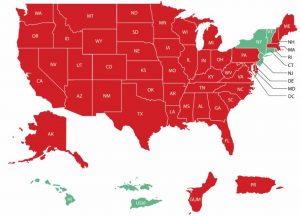
For more information about the tri-state advisory, including a full list of states with a high infection rate, please click here. The map below also indicates which states are listed on the advisory (red), and which are not (green).
Public Health Guidance for Sports
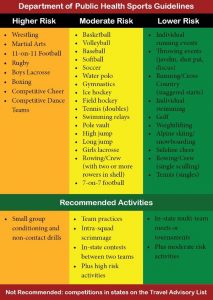
The Connecticut Department of Public Health (DPH) has updated its guidance for sports activities deemed high, moderate, and low risk. See below for a chart detailing which activities are advisable as we enter the winter months.
You can also visit DPH’s website for more guidance on interscholastic, youth, and other amateur sport activities during the COVID-19 pandemic: Click Here
REMINDER: CT Now in Phase 2.1
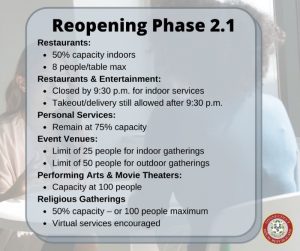
In response to an increase in Connecticut’s COVID-19 infection rate, Governor Lamont has ordered the state to return to an amended version of Phase Two. The governor has also moved the state from a local response model back to a statewide action plan.
As such, the following restrictions are now in effect:
Restaurants
- Reduced to 50% capacity with a maximum of 8 people per table
Restaurants & Entertainment (i.e bowling alleys, movie theaters, arcades)
- Required to close by 9:30 p.m. for dine in services, with the exception of food takeout and delivery services, which will be allowed to continue after 9:30 p.m.
Personal Services (i.e. hair salons and barber shops)
- To remain at 75% capacity
Event Venues
- Limited to 25 people indoor, 50 people outdoor
Performing Arts & Movie Theaters
- Limited to a maximum capacity of 100 people
Religious Gatherings
- Limited to 50% of the building’s capacity or a maximum of 100
- Virtual services are encouraged
Employers
- Encouraged to maximize telework to the extent possible
Seniors/Individuals Living with Chronic Conditions
- Those over 60 and/or those with chronic health conditions are urged to remain home as much as possible.
The state’s Department of Public Health (DPH) has issued a statewide public health advisory urging residents to limit non-essential trips outside the home from 10:00 p.m. to 5:00 a.m.
DPH has also released its weekly COVID-19 Alert Map, which now includes many CT municipalities, including New Canaan and Wilton, that are in the red-zone alert level – the highest of the state’s four alert levels.
For more information, please take a moment to review the following resources and updates from state officials:
- Governor’s 11/2 Update: Click Here
- Governor’s 11/5 Update: Click Here
- Executive Order 9K: Click Here
PURA Announces Rate Changes for Eversource
The state’s Public Utilities Regulatory Authority (PURA) has announced revised standard service generation rates (or supply rates) for Eversource and United Illuminating customers beginning January 1, 2021. This is separate from Eversource’s delivery rate, which PURA had initially approved for an increase beginning July 1, 2020. Following public pressure, the delivery rate increase was put on hold and is currently under review by PURA following multiple public hearings. PURA is expected to deliver a decision on the delivery rate issue later this month.
The supply rate is the cost to produce the electricity for customer, whereas the delivery rate is the cost to transfer the power to end-users. This increase, which typically happens each year in January due to increased energy demand during the winter months, only applies to customers who do not receive their power from a third-party supplier.
Customers may compare rates here.
Read PURA’s full Press Release: Click Here
If you have any questions about these updates or any other state issue, please do not hesitate to contact me.
Email: Tom.ODea@housegop.ct.gov