
CT's Unfunded Pensions - PART II
Key Takeaways
- Lawmakers must prioritize pension reforms to avoid higher taxes.
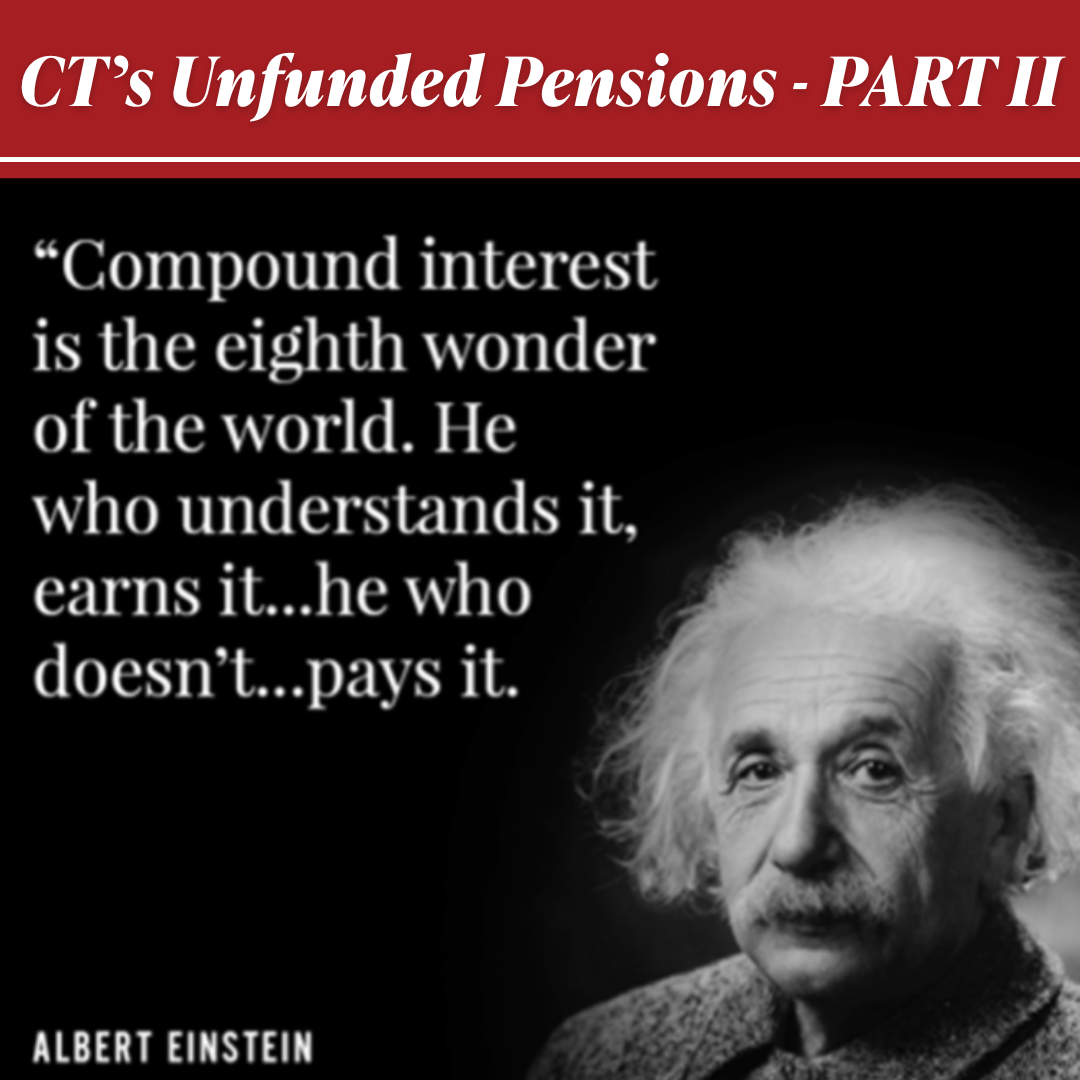
Albert Einstein (credited with this quote), Warren Buffet, Benjamin Franklin, Benjamin Graham, the ancient Chinese and many others have recognized the game-changing power of compounding.
Compounding grows an asset or a liability by increasingly larger amounts over time, as interest is added to the principal creating a larger base every year. If you invest $100 today at 10% interest, at the end of the year, you will have earned $10 (100 x.10). Your new (larger) balance of $110 now invested for a year will earn $11 ($110 x.1). Now you have $121. That even larger balance now invested for a year yields $12.10, and so on.
As stated in Part I, “CT’s 800-Pound Financial Gorilla” CT has over $103 billion of pension liabilities and only $49.5 billion of pension assets to pay those liabilities. (1) We therefore have unfunded pension liabilities ($103-$49.5) of $54 billion. This unfunded liability functions like debt and one of the reasons why CT has the highest debt burden per taxpayer of any state in the country (tied for last with NJ). (2) Because CT’s pension liabilities are more than twice our assets, and because our assets sometimes grow but liabilities have always grown, compounding can work against CT’s financial future and the taxpayer.
Connecticut’s pension assets have grown at a compounded rate – in some years. CT’s $49.5 billion in pension assets are invested by the State Treasurer and projected to earn returns of 6.9% per year, compounded. (3) While that is a reasonable projection, it is not a sure thing. In fiscal year 2022, CT’s pension plans earned a (-10.8)% annual return, (yes a negative return) (4) and for the 5 years ending 2022, our returns ranked 49th among 50 states. The state has improved its rate of return in recent years. These have been banner stock market years, however, and banner years do not last forever.
Connecticut’s pension liabilities have grown at a compounded rate – every year.
Every year that a current CT state employee works, he/she accrues a pension liability - what the state will owe once he/she retires. In addition, because people are living longer, pension liabilities for already-retired persons are also growing. Finally, the state of CT has applied a cost-of-living increase (COLA) to our state pension liabilities every year since 1972. Any year the CPI is positive, that compounded growth of our pension liabilities will also continue.
Why Should We All Care?
The pension issue is significant because pension expenditures represent such a large part of CT’s annual state budget – almost 25% of our General Fund or $6 billion in 2024. We debate the merits of many worthy expenditures in the legislature – e.g., $40 million for special education, $200 million to fund preschool – but our pension expenditures dwarf those numbers. Pensions are an enormous drain on our state budget, and ultimately – the taxpayer.
What Can We Do?
Since 2020 and thanks to the Fiscal Guardrails, CT has paid in $8.7 billion to reduce our unfunded pension liability. Because of compounding, that $8.7 billion has freed up $737 million in CT’s General Fund spending for every year going forward. (5) In other words, the more and the sooner CT pays down its pension debt, the more compounding can work in our favor.
In 2025, the Legislature made a drastic departure from this positive path by amending the Guardrails and diverting approximately $1.2 billion of funds away from our pension assets. That $1.2 billion would have been compounding for us and shrinking the annual payment required from the state’s budget. I voted against this diversion of funds, along with all other Republicans and two Democrats. (6)
Compounding is powerful. The Fiscal Guardrails work for CT’s taxpayers. In 2025, the Legislature lost its resolve to stick to them, and this set CT’s financial progress back. Let’s get back on track in the 2026 legislative session.
Sources:
(1) Figures are most current available figures provided by State of Connecticut’s nonpartisan Office of Fiscal Analysis on 9/26/25 and represent totals for FY2023. Please contact Rep. Courpas for any backup needed.
(2) Financial State of the States, Truth in Accounting, 2025. Click here.
(3) State Treasurer News Release, Click Here. Click here.
(4) Click here.
(5) Click here.
(6) Changes to Volatility Cap: Click here