Latest News
Loading articles...
Loading photos...
State Representative
District
112th
Towns
3
Latest Updates
Swipe through recent posts
-2.png)
PURA has announced five opportunities for residents to weigh in on Eversource's latest rate request, four in person and one remote. The closest in-person hearing is scheduled for Danbury. You can comment in person next month: -Monday, November 23 @ 5:30PM - WCSU's Ives Concert Hall, 181 White Street, Danbury or -Wednesday, December 9 @ 12:00PM - VIA Zoom https://ctdeep.zoom.us/meeting/register/ooBYaXdqRQy9DElAsFoBPw#/registration Written comments accepted here: https://portal.ct.gov/pura/about/filing-and-forms/make-an-electronic-filing PURA cautioned that these are not intended to be forums for questions, discussion, or direct engagement with commissioners. For the rate year, Eversource proposes an increase in distribution operating revenues of approximately $727 million. This represents an increase of approximately 16% over the currently allowed overall revenues, and approximately 50% over currently allowed distribution revenues. According to the Application, revenues for the remainder of the four-year term would be calculated within the annual Rate Adjustment Mechanism (RAM) proceeding.
.png)
Several new laws will take effect October 1st that could have an impact on you, your business, or our community. I have highlighted some of them below. I co-sponsored a bill to recognize and honor our veterans . Among the provisions is one that allows the fee to be waived for a driver's license for any Department of Veterans Affairs verified veteran. The bill also creates a Veterans Dental Care Program to help eligible veterans get certain dental services. The bill sets an annual program cap of $3,000 per eligible veteran for covered services. We also passed bills to help protect public safety on our roadways. One bill taking effect October 1 would increase the penalty for a driver who is observed illegally passing a stopped school bus three or more times. They will now have their driver’s license suspended for six months. Under a different bill, distracted driving in a highway work zone will now be considered reckless driving, increased from being classified as a misdemeanor. Other major acts include: An Act Concerning the Nonissuance of a Standing Criminal Protective Order in the Case of a Family Violence Crime An Act Concerning the Use of Technology for Virtual Monitoring in Residential Care Homes An Act Concerning Child Welfare Accountability and Transparency An expanded list of those that will take effect on October 1, along with summaries, can be accessed here . Feel free to share this information with anyone who may benefit from it.

Students in Easton and Trumbull are starting a new school year this week, while Monroe students will be back in class on August 31st! That means buses will be back on the roads and children waiting at the end of their driveways or on the side of a road for the bus. I supported a bill this session , which was signed into law, requiring a mandatory six-month suspension of a license of any driver who, a third or subsequent time, is caught violating the state law on stopping for school buses. Under existing law, drivers must stop their vehicles generally at least ten feet from the front or rear of a school bus that is displaying its flashing red signal lights and remain there until the bus no longer displays lights. Any person who violates this law faces a $450 fine for the first offense and a fine of $500 to $1,000, up to 30 days in prison, or both for a subsequent offense. I wanted to remind everyone to be careful on our public roadways when school is in session, especially near bus stops, schools, playgrounds, and athletic fields. Safety tips for drivers: State law prohibits passing a school bus with its lights flashing. Some school buses are equipped with cameras to record passing drivers. Observe the no-passing law and expect the unexpected when traveling near school buses in school driveways. Watch for children, especially when driving in neighborhoods with school zones. Watch for children walking in the street, especially if there are no sidewalks in the neighborhood. Safety tips for parents and children: Be waiting at your bus stop 5 minutes ahead of the scheduled pick up. Wait 10 feet back from the road and wear visible clothing. Always wait for the bus driver's head nod before boarding the bus or crossing the street. They're watching out for you! Avoid distracting the bus driver for anything other than an emergency.

Connecticut's annual Sales Tax Free Week begins on the third Sunday of August and runs until the following Saturday. This year it’s August 16 through August 22, 2026. This is timed in the run up to the start of the new school year when families are shopping for back-to-school clothing. There are some changes to the program, starting this year. Under a bill I voted for, we've increased the price cap per item and added new items qualified as sales tax free. Now, backpacks and cleated shoes will be sales tax free during this upcoming event. This tax holiday applies to in-person purchases and purchases made online. The exemption applies to each eligible item costing under $300, up from $100, regardless of how many of those items are sold to a customer on the same invoice. Tax is calculated on the final sales price, after all reductions and coupons have been calculated, of each item. You can find answers to frequently asked questions about the program on the Department of Revenue Services website .
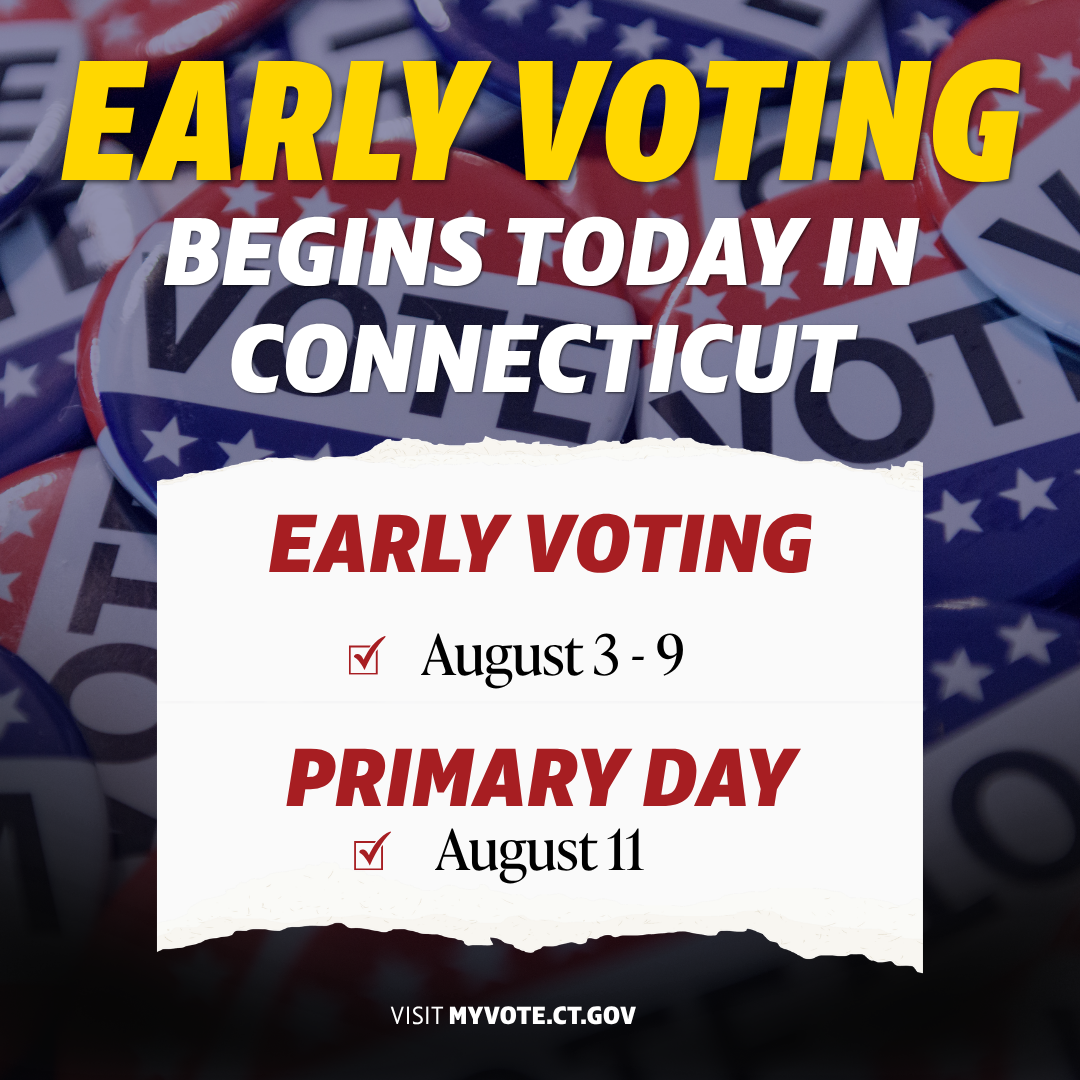
Early voting for the August 11, 2026 Primary is underway. Democratic and Republican Primaries will be held on Tuesday, August 11 , 2026, 6 AM to 8 PM at the following locations in Monroe: Democratic Primary: All districts (1, 2, 3 & 4) Governor District 1: Fawn Hollow Elementary School, 345 Fan Hill Road USE Main Entrance District 2: Stepney Elementary School, 180 Old Newtown Road USE Main Entrance District 3: Monroe Elementary School, 375 Monroe Turnpike USE Main Entrance District 4: Masuk High School, 1014 Monroe Turnpike USE Main Entrance Republican Primary: All districts (1, 2, 3 & 4) U.S. Representative in Congress 4 District 1: Fawn Hollow Elementary School, 345 Fan Hill Road USE Main Entrance District 2: Stepney Elementary School, 180 Old Newtown Road USE Main Entrance District 3: Monroe Elementary School, 375 Monroe Turnpike USE Main Entrance District 4: Masuk High School, 1014 Monroe Turnpike USE Main Entrance Primary Day, Tuesday, Aug. 11, polls will be open from 6 a.m. to 8 p.m. at the Staples Elementary School Cafetorium in Easton . Primary Day, Tuesday, Aug. 11, polls will be open from 6 a.m. to 8 p.m. for District 4 in Trumbull at Madison Middle School. Only registered Democrats or Republicans can vote in their respective Primary. EARLY VOTING for these Primaries will be available August 3 – 9, 10 AM – 6 PM, 8AM – 8PM on August 4 and 6. Locations: Community Center Site , 709 Monroe Turnpike, Monroe. Community Room at the Easton Library 691 Morehouse Road Community Room at the Trumbull Library at 33 Quality Street